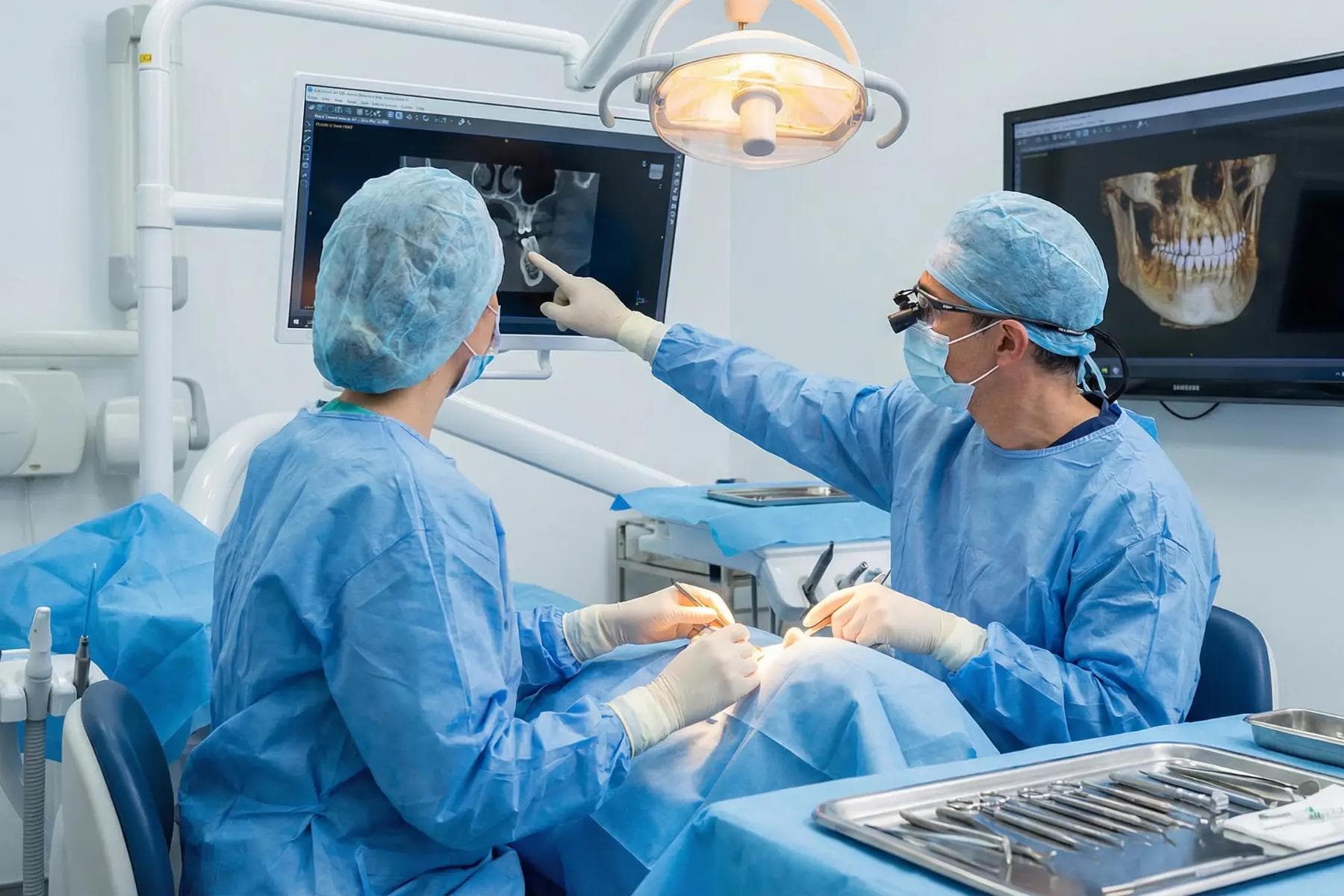
A surgeon's hands are their career. One injury, one diagnosis, one tremor — and the ability to operate is gone. That is not a distant risk: roughly one in four workers will experience a disability before retirement, and surgeons face higher-than-average exposure, given how much their income depends on precision, fine motor control, and physical endurance.
Switzerland's state disability pension (IV) pays a maximum of CHF 2,520 per month in 2026, including a fraction of what most surgeons earn. Pillars 1 and 2 combined cover roughly 60% of salary, and only for employed surgeons earning above the BVG threshold. For surgeons, especially self-employed specialists, disability insurance for medical professionals in Switzerland is not optional; it is foundational.
This guide explains how the Swiss system works for surgeons, what own-occupation coverage means in practice. It outlines how different surgical specialties are assessed and how to choose the right policy.
How Swiss Disability Coverage Works for Surgeons
Switzerland's disability framework runs on three pillars. For most professionals, Pillars 1 and 2 form a useful base. For surgeons, there are rarely enough, which is why surgeons’ disability insurance and own-occupation disability insurance options matter so much at the private-cover level
Pillar 1: IV/AI (State Invalidity Insurance)
The IV (Invalidenversicherung / Assurance-invalidité) is Switzerland's state disability insurance. Every resident contributes to it through salary deductions. The maximum full IV pension in 2026 is CHF 2,520 per month, calculated based on contribution history and the assessed degree of disability.
Crucially, IV uses an any-occupation framework. It assesses whether you can do any work at all, not whether you can continue as a surgeon. A surgeon who cannot operate but could technically consult or teach may receive only a partial pension, or none at all. IV benefits also include rehabilitation and retraining support, designed to return people to work rather than maintain income indefinitely.
Pillar 2: BVG/LPP (Occupational Pension)
Hospital-employed surgeons are covered through their employer's BVG fund. If disability occurs while employed, the BVG fund pays a disability pension alongside IV. Together, Pillars 1 and 2 are designed to replace around 60% of the last insured salary. However, only up to the maximum insured BVG salary ceiling.
Self-employed surgeons who run their own practice or work freelance are not automatically included in Pillar 2. They must either voluntarily join a BVG pension fund or rely entirely on private cover.
For high earners, the BVG ceiling means the actual replacement rate drops well below 60% in real terms.
Pillar 3: Private Disability Insurance
This is where surgeons genuinely protect their income. Private disability insurance, also called loss-of-earnings insurance, bridges the gap between what Pillars 1 and 2 pay and what a surgeon actually needs.
Own-occupation policies are the gold standard here. They assess disability based on the specific duties of surgery, not general work capacity. They also can typically ensure up to 70–80% of gross income, subject to the insurer's maximum benefit amount.
What Is Own-Occupation Disability Insurance for Surgeons?
Own-occupation disability insurance pays a benefit when an insured person can no longer perform the specific duties of their own occupation. This is distinct from "any-occupation" policies, which only pay if the insured person cannot do any work at all. For surgeons, that distinction is critical.
Practical Example
A vascular surgeon develops cervical disc disease that prevents them from maintaining operative posture for extended procedures. Under an own-occupation policy, this is a total disability claim — even if the surgeon could continue teaching, writing, or consulting. Under an any-occupation policy, the claim would likely fail.
In Swiss insurance terminology, the relevant concepts are Berufsunfähigkeit (occupational incapacity) and Erwerbsunfähigkeit (general earnings incapacity). Own-occupation disability insurance surgeon policies are structured around Berufsunfähigkeit, the inability to practice your specific profession.
Most private disability insurance in Switzerland can be structured to include a Berufsunfähigkeit definition. However, the exact wording varies between insurers, so reviewing the definition clause before signing is essential.
Partial or residual disability provisions matter too. If a surgeon can return to theatre but at reduced hours or capacity, partial benefits should pay proportionally, preventing a sharp all-or-nothing outcome. Among the best disability insurance policies for surgeons, this partial-benefit clause is usually what separates a genuinely protective contract from one that only pays out in worst-case scenarios.
Disability Insurance for Surgical Specialties
Not all surgical specialties carry the same risk profile. Insurers assess each specialty differently, both in terms of what triggers a disability claim and how they price the policy.
1. Disability Insurance for Trauma Surgeons
Trauma surgery is physically demanding. Long, unpredictable procedures, exposure to bloodborne pathogens, and sustained physical posture create cumulative musculoskeletal risk. Disability insurance for trauma surgeons should prioritise an own-occupation definition and short elimination periods — trauma surgeons often cannot afford a long waiting period before benefits start. Occupational exposure to infection is also a coverage consideration worth checking for in the policy terms.
2. Disability Insurance for Vascular Surgeons
Vascular surgery demands exceptional hand precision and sustained concentration. Even a minor condition affecting fine motor control can remove the ability to operate safely.
Vascular surgeons also tend to be higher earners in the Swiss medical system, which increases the coverage amount needed and makes the Pillar 1 + 2 gap even larger. This is a key reason vascular surgeon disability insurance is usually structured with a higher benefit ceiling than standard policies.
3. Disability Insurance for Oral and Maxillofacial Surgeons
Oral and maxillofacial surgeons often work in private practice or partnership structures. This makes them more likely to be self-employed and therefore without automatic Pillar 2 coverage. Their work combines dental and surgical precision, meaning both hand control and visual acuity are essential occupational capabilities.
Oral and maxillofacial surgeons
Oral surgeon disability insurance should include own-occupation definitions. They specifically cover surgical procedures, not general rental work.
OB/GYN surgeons perform a hybrid role, both medical management and surgical procedures, which creates a more nuanced disability picture.
A condition that prevents surgical work may not prevent obstetric or gynaecological consultation. Therefore, policies should be clear about how partial disability is handled across the two functions.
It's also worth noting that female surgeons, who are more common in OB/GYN than in many other specialties. They typically pay higher premiums for disability insurance for this coverage due to actuarial tables.
How Much Does Surgeon Disability Insurance Cost in Switzerland?
Premium is not a fixed figure. Several variables combine to determine the cost of disability insurance for surgeons in Switzerland:
Factor
Effect on Premium
Surgical specialty
Higher fine-motor dependency means higher risk classification
Age at application
Premiums rise roughly 3–5% per year of age; locking in early saves significantly over a career
Sex
Female premiums differ from male premiums for some products, due to actuarial factors
Health history
Even minor pre-existing conditions can raise premiums or trigger exclusions
Benefit amount
Higher monthly benefit means higher premium
Elimination period
Longer waiting periods reduce premiums meaningfully
Riders included
COLA, future insurability, and residual disability each add cost
Employment status
Self-employed surgeons may be priced differently than hospital-employed surgeons
Surgical specialty
Effect on PremiumHigher fine-motor dependency means higher risk classification
Age at application
Effect on PremiumPremiums rise roughly 3–5% per year of age; locking in early saves significantly over a career
Sex
Effect on PremiumFemale premiums differ from male premiums for some products, due to actuarial factors
Health history
Effect on PremiumEven minor pre-existing conditions can raise premiums or trigger exclusions
Benefit amount
Effect on PremiumHigher monthly benefit means higher premium
Elimination period
Effect on PremiumLonger waiting periods reduce premiums meaningfully
Riders included
Effect on PremiumCOLA, future insurability, and residual disability each add cost
Employment status
Effect on PremiumSelf-employed surgeons may be priced differently than hospital-employed surgeons
Factors affecting surgeon disability insurance
As a general orientation, disability insurance for surgeons typically costs between 1% and 3% of annual gross income per year. For a surgeon earning CHF 250,000, that range implies roughly CHF 2,500–7,500 per year.
Tax Note
Self-employed surgeons in Switzerland can generally deduct disability insurance premiums as a business expense. It reduces the net cost meaningfully. Confirm the details with a tax adviser for your specific cantonal situation.
Pricing depends on so many moving parts, such as specialty, age, health history, and structure. The fastest way to see a realistic number is to get a disability insurance comparison for surgeons rather than rely on a generic estimate.
Factors to Choose the Right Disability Insurance Policy
The policy definition is the most important thing. But several other features determine whether the policy actually performs when a claim is made:
Own-occupation definition: Confirming the policy uses Berufsunfähigkeit as the triggering definition. That "your occupation" is defined as surgery specifically, not medicine generally.
Benefit amount: Most Swiss policies insure 60–80% of gross income. Surgeons with higher incomes may need to coordinate benefits across multiple policies to close the gap.
Elimination (waiting) period: The delay between disability onset and the first benefit payment. Common periods are 30, 90, or 180 days. Surgeons with strong liquid reserves may choose a longer elimination period to reduce premiums.
Benefit period: Policies that pay until age 65, aligned with Swiss retirement, provide the strongest long-term protection.
Residual and partial disability benefits: A surgeon who returns to partial practice should receive proportional benefits rather than losing cover entirely.
Non-cancellable and guaranteed renewable terms: The insurer cannot cancel the policy or change its terms if your health changes; only a premium increase is permitted.
Future insurability rider: It allows you to increase coverage as your income grows without new medical examinations, especially important for surgeons early in their career.
Cost of living adjustment (COLA): The change increases benefits annually during a claim, protecting against inflation over long-term disabilities.
Pro Tip
The definition clause matters more than the premium. A cheaper policy with an any-occupation definition, or a vague "own occupation" clause. It isn't tied specifically to surgery, can leave a claim exposed exactly when it's needed most.
Top Surgeon Disability Insurance Providers in Switzerland
Several Swiss-based and international insurers offer disability insurance products suited to medical professionals, including:
Helvetia
Basler/Baloise
Zurich Insurance
Swiss Life
Generali
AXA Switzerland
Mobiliar
Not all products are equal for surgeons. What matters isn't just the insurer's name. It's whether the specific product:
Uses an own-occupation definition built for medical professionals
Has a track record of handling claims fairly for doctors
Some insurers also offer specialist medical packages that bundle disability income protection with life insurance. In some cases, professional liability coverage is useful for self-employed surgeons running their own practice.
Combining disability and life insurance
Many surgeons pair a disability income policy with life insurance, especially if they have:
Practice buyout obligations
Employed staff
Family dependents
Some policies bundle term life with a disability rider, which can simplify premiums and admin. Self-employed surgeons should also look at business overhead expense coverage. A separate policy pays practice running costs (staff salaries, rent, equipment leasing) during a disability, on top of personal income replacement.
How MedCourtage Helps
As a specialist medical insurance broker, MedCourtage compares policies across Swiss insurers to find the right structure for your surgical specialty and employment arrangement.
Profile & Needs Assessment: We analyze your surgical specialty, current coverage, and specific risk exposure to identify gaps and priorities.
Access to Tailored Coverage: Our in-depth market knowledge gives you access to stronger, better-performing policies at a fairer price.
Expert Analysis & Comparison: We compare offers across multiple insurers on coverage, exclusions, limits, premiums, and long-term conditions, and deliver a clear, transparent recommendation.
Choose the Right Disability Insurance for Surgeons
We design tailor solutions to secure your daily practice and provide you with lasting peace of mind.
FAQ
Yes. Self-employed surgeons are not automatically covered under Pillar 2 (BVG). Pillar 1 (IV) pays a maximum of CHF 2,520/month — far below the income most surgeons need to protect. Private own-occupation disability insurance is essential.
Conclusion
For most professionals, Switzerland's Pillar 1 and Pillar 2 system offers reasonable protection. For surgeons, it rarely does.
The state pension caps at CHF 2,520 a month.
The occupational pension only applies to employed surgeons above a salary threshold.
Self-employed specialists often have no automatic coverage at all.
An own-occupation policy, priced and structured correctly for your specialty, is what actually closes that gap.
If you're ready to see what that looks like for your situation, compare disability insurance for surgeons with a specialist broker who understands how insurers price and settle claims for medical professionals.